DeliveryPricing
Marley Spoon needed to reshape customer behaviour without damaging customer trust. I was briefed on the business problem and the pricing structure. From there I owned the design end to end, with no PM, no interaction spec, and no copy brief. Six markets, two brands. One feature that resolved a €7.5m infrastructure crisis.
An operational crisis hiding inside aUX problem.
In Australia, 43% of all delivery volume was concentrated on Monday, pushing production to its limits on weekends, when labour is least available and most expensive. The company was weeks away from breaching warehouse capacity.
Marley Spoon was actively considering opening a second fulfilment centre at a cost of up to €7.5 million. If a pricing mechanism could rebalance demand, they could serve 44,000 orders per week from existing infrastructure, deferring that investment entirely.
The business solution was differentiated delivery pricing. My design challenge was making that feel fair to customers. The PM briefed me on the business problem and the pricing structure, then left the project. I partnered directly with Engineering and aligned stakeholders across operations, finance, customer service, and C-level on every significant decision.
I conducted a competitor review, defined the interaction pattern, determined where and how pricing should appear in the funnel, identified the need for confirmation states, and wrote all six versions of the copy myself.
43%
of AU delivery volume concentrated on Mondays
2x
Peak production day vs daily average, an unsustainable imbalance
€7.5m
Fulfilment centre investment under consideration to handle peak demand
The principle before thepattern.
Before opening Figma, I reviewed how other services handle variable pricing, covering meal kit competitors and delivery platforms. The consistent pattern across the best implementations was transparency at the point of selection: pricing visible before commitment, not revealed at checkout. That became the core design principle.
The existing delivery step had two dropdowns: one for day, one for time slot. No pricing was shown. Customers had no reason to choose one slot over another.
I explored three interaction patterns: keeping pricing inside the dropdown, a calendar-based view, and visible cards. The dropdown couldn't accommodate pricing clearly at mobile widths. The calendar added navigation complexity without benefit. Cards gave enough space to show the adjustment clearly, kept the selection scannable, and worked consistently across markets with different slot configurations.
Pricing visibleat the point of selection.
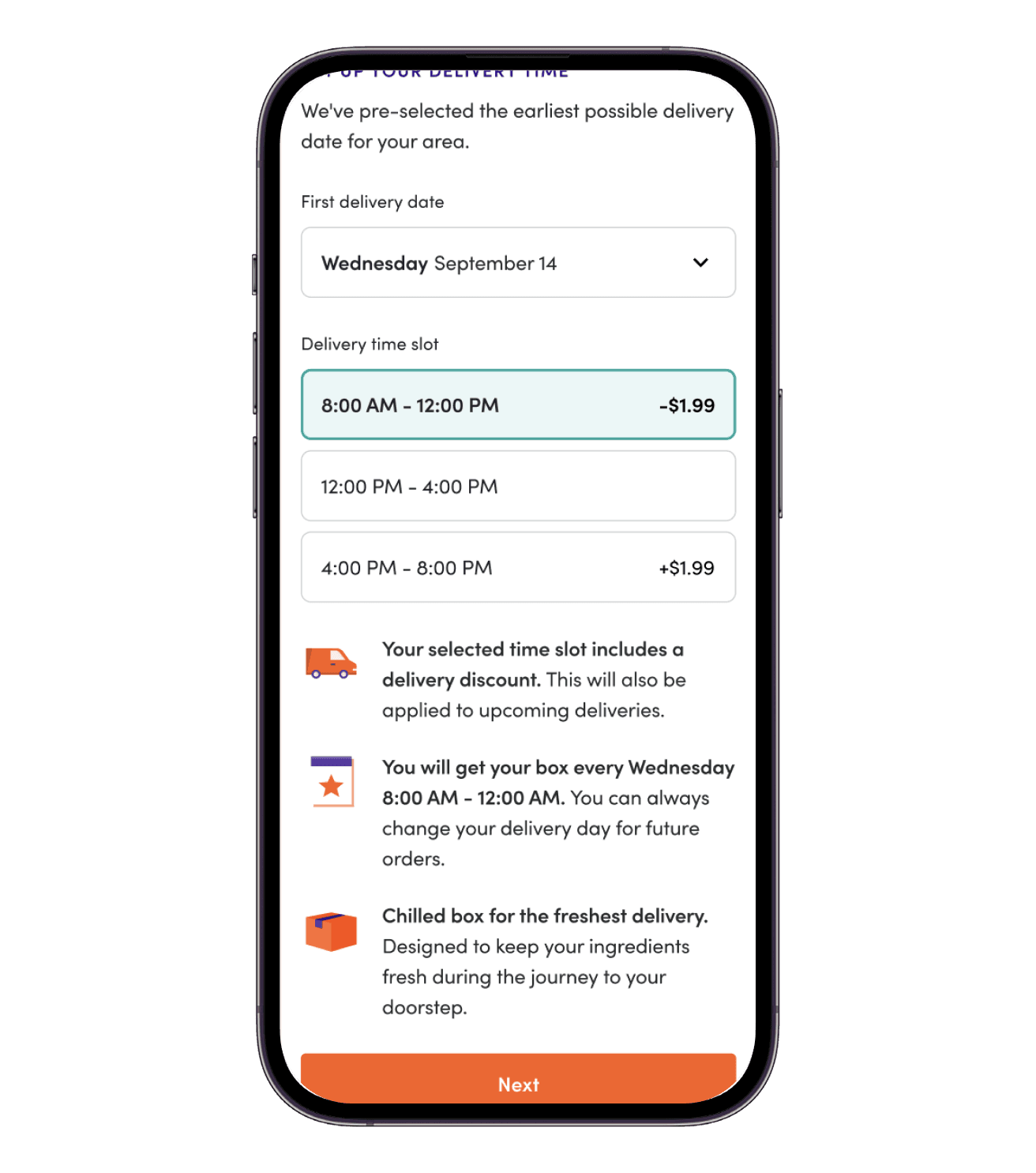
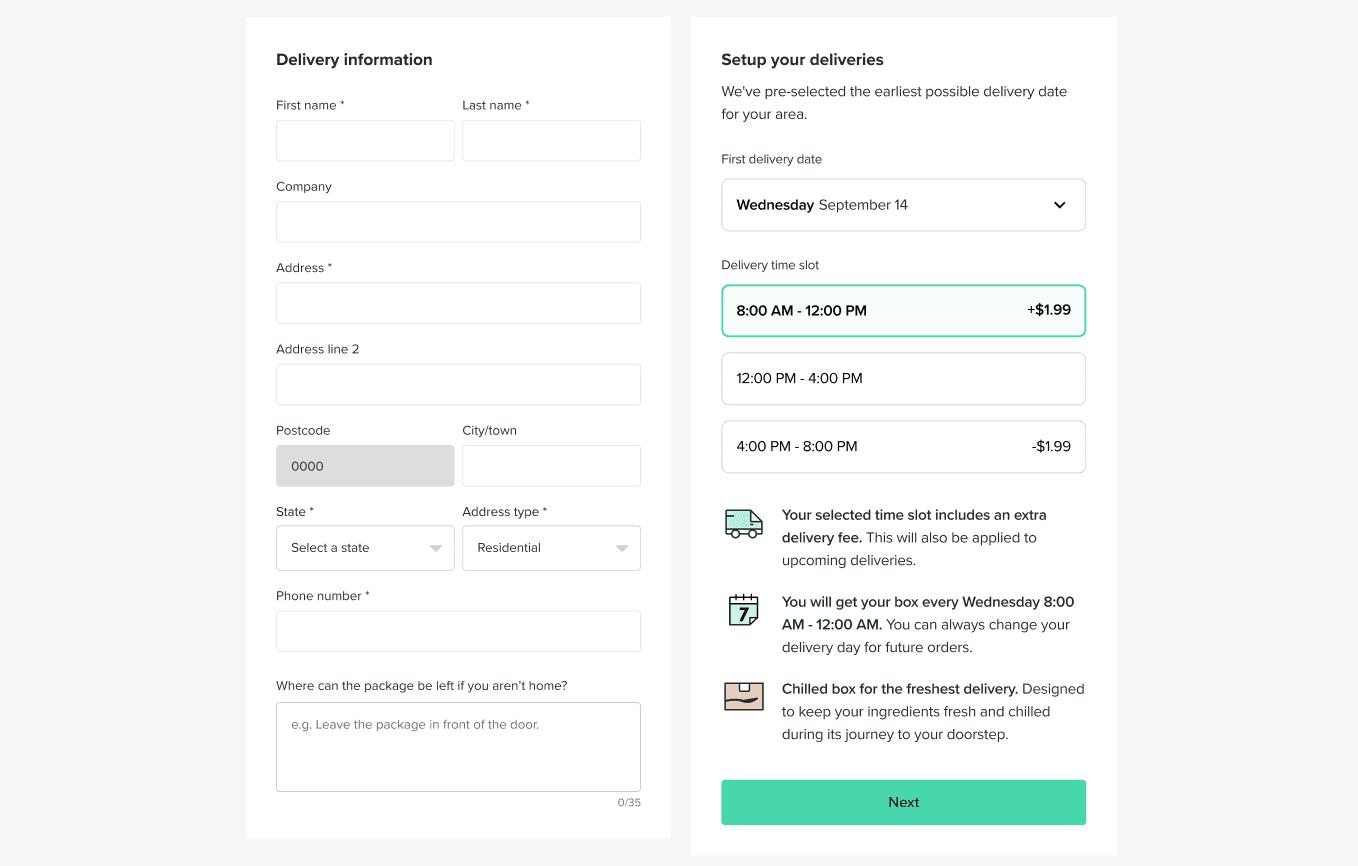
The delivery details step previously showed two dropdowns, one for day and one for time slot, with no pricing shown at all. I kept the day selector as a dropdown but redesigned the time slot selector into visible cards, adding the surcharge or discount delta inline. Customers see +$1.99 or -$1.99 at the moment of selection. The mechanism works differently by market: in Australia, one time slot is available per day, so the pricing incentive is at the day level, Monday is surcharged, Friday discounted. In European markets with multiple time slots per day, pricing varies by window within a day. The surcharge or discount also appears as a line item in the checkout summary, ensuring the pricing is consistent and visible across both the selection step and the final confirmation.
One feature.Every team involved.
Shipping this required alignment across more stakeholders than any other project I worked on. Operations needed confidence the pricing mechanism would actually shift behaviour. Finance needed accuracy in how surcharges were represented. Customer service needed copy that would reduce inbound complaints. Engineering needed an interaction model that could flex across six markets with different pricing structures and slot configurations. I coordinated all of it without a PM.
Transparency over concealment.Choice over obligation.
Each decision below resolved a real constraint between the business requirement, the customer experience, and the engineering implementation. The interaction pattern, where and how pricing appears in the funnel, the confirmation states, and all six versions of the copy.
I redesigned the time slot selector from dropdown to visible cards
The delivery details step previously had two dropdowns with no pricing shown. I redesigned the time slot selector into visible cards so any surcharge or discount is immediately visible when a day is selected. Pricing is present at the moment it's relevant.
I placed the pricing delta at the time slot level, not in the day dropdown
Showing pricing inside the day dropdown would have been too cramped, especially on mobile. The time slot card gives enough space to show the adjustment clearly. In AU with one slot per day this effectively communicates day-level pricing. In EU markets with multiple slots per day, customers can compare options within a single day.
Showed only the surcharge or discount delta, not the full shipping cost
The full shipping price is already shown on the plan selection step and at checkout. At step 3 I showed only what was new, the adjustment. This keeps the step focused without duplicating information the customer has already seen or will see again.
I identified the need for confirmation states
Selecting a time slot with variable pricing created a moment of uncertainty. The customer needed to know what they'd just committed to. I identified this gap, designed the confirmation states into the flow, and wrote all six versions of the copy myself.
I designed six confirmation states across two pricing contexts
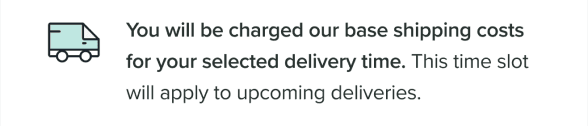
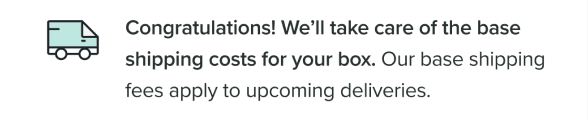
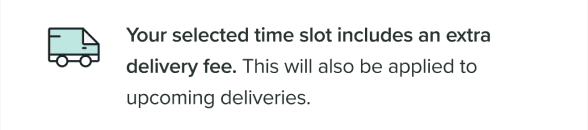
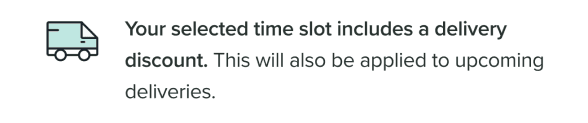
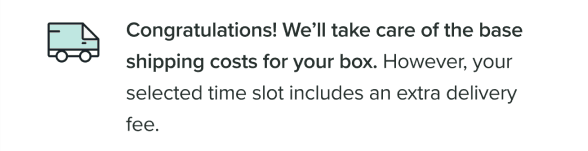
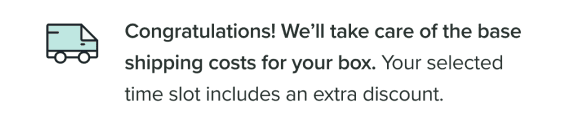
The message updates based on two variables: the slot selected and whether the customer has a free shipping voucher. Without a voucher: surcharge is neutral, standard is reassuring, discount is positive. With a voucher: all three open with "Congratulations!" but accurately communicate any surcharge or discount on top. Six states, each saying something true.
I defined the selected and hover states
Green outline for selected, pale green for hover. These were my decisions, reinforcing which slot is active and making the interaction feel responsive without adding visual noise.
Same step.Six different messages.
The confirmation message updates automatically based on two variables: which time slot the customer selects, and whether they have a free shipping voucher. I identified the need for these states, designed them into the flow, and wrote all six versions of the copy. Each one is calibrated to make the customer feel informed rather than penalised.
Different brand.Cross-platform.
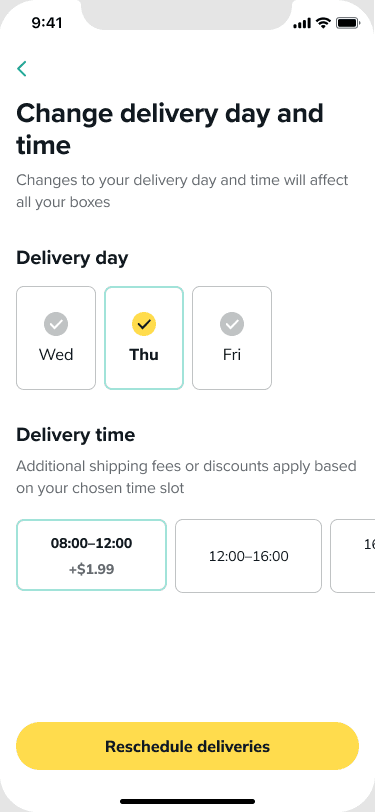
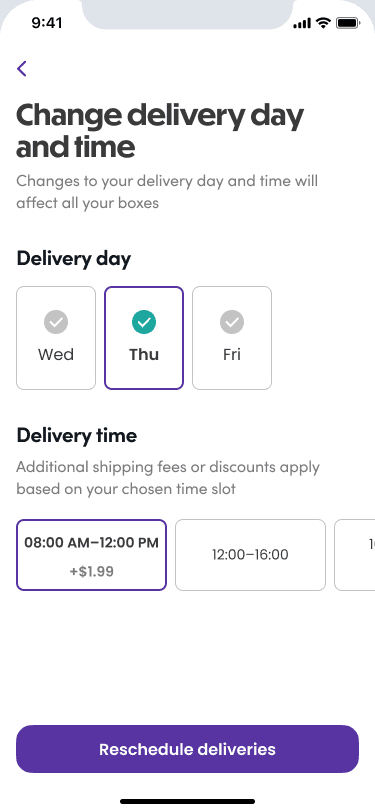
The same pricing logic surfaces in the iOS account area, where existing customers can reschedule their delivery, with consistent same-day selection and slot-level pricing visibility adapted for native mobile. In parallel, I designed the full feature for Dinnerly.
While Dinnerly targets a more budget and family-focused audience with a distinct visual identity, the underlying interaction logic and pricing model remain consistent.
One pattern.Applied system-wide.
After Delivery Pricing shipped, I added the redesigned time slot card component to the Marley Spoon design system for consistent cross-team use.
More significantly, I standardised the selection pattern system-wide. The green outline selected state and pale green hover state I defined were applied to all existing selector components. Any designer working on a selector anywhere in the product follows the same visual rules.
The feature worked.The investment was deferred.
43→25%
Monday delivery volume reduced from 43% to 25%, a near halving of peak day concentration.
€7.5m
Planned fulfilment centre investment deferred. The capacity pressure that had driven the business case was resolved.
6 markets
AU, US, DE, NL, BE, and AT, each with different pricing structures and time slot configurations.
Designing at the intersection of business
and trust.
This was the most complex design problem I worked on at Marley Spoon, not because of UI complexity, but because of what was at stake. A pricing change in a subscription product touches customer trust directly. Get the framing wrong and you create churn. I was navigating that risk without a PM, which meant every call about tone, transparency, and interaction pattern was mine to own and defend.
The most important decision I made was the six-state confirmation copy. It would have been easy to write one neutral message everywhere. Instead I treated each pricing outcome as a different emotional moment, and that's why the feature launched without significant customer backlash.
If I were to do this again, I'd push earlier for a formal test of the different copy framings, to validate that the celebratory “Congratulations” was actually driving behaviour shift rather than just feeling good in design review.